
For the sugar farmer in Mumias, the debate over imported sugar is not just about figures, tonnes or government policy. It is about whether the cane growing on his farm will continue to put food on the table and whether the factory that buys his crop will remain busy.

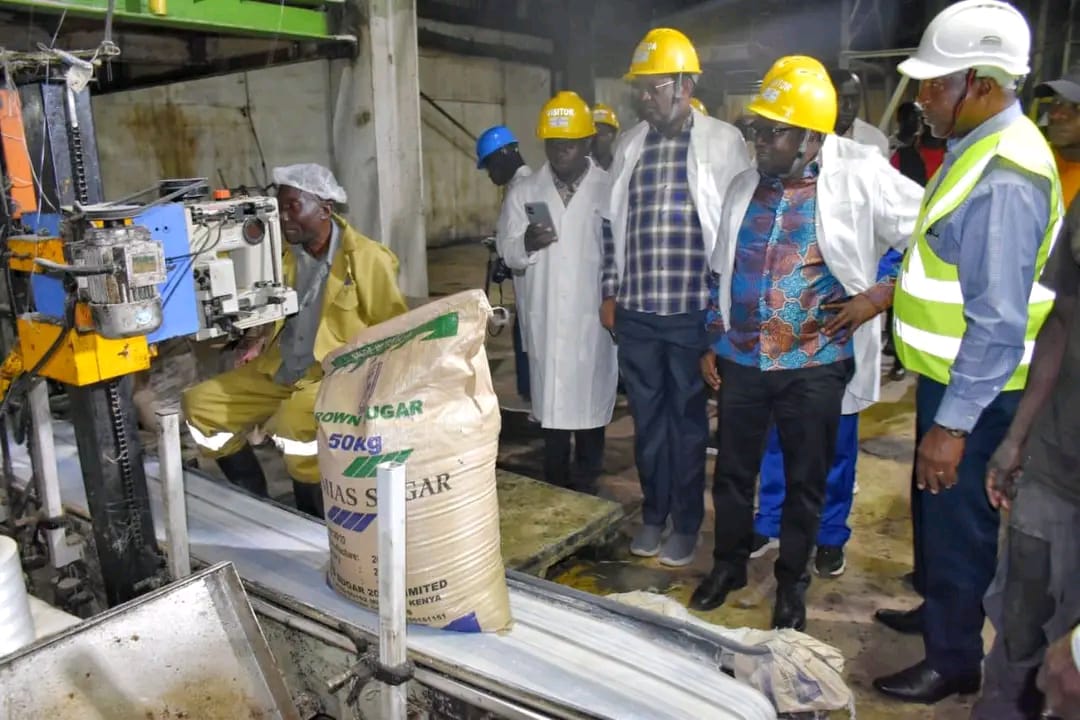
That was the human face of the sugar importation debate when the National Assembly Departmental Committee on Trade, Industry and Cooperatives, led by its chair Hon. Benjamin Shinali, visited Mumias Sugar Company on Wednesday to hear from the miller and other stakeholders.
The committee, which included Masinga MP Joshua Mbithi and North Horr MP Hon. Guyo Adhe Wario, was joined by members of the Kakamega County Assembly Committee on Trade.
The lawmakers were in Mumias to follow up on the importation of raw sugar into the country for industrial use and assess what it means for local millers, farmers and businesses whose livelihoods are tied to the sugar industry.

Speaking during the visit, Shinali said the committee was not coming to Mumias with predetermined answers but wanted to listen to those directly involved in the industry.
“We are here to collect views and suggestions on how we can also protect the sugar industry. We want to see how we can protect the sugar manufacturer while at the same time protecting our local farmers,” Shinali said.
He said the country must find a delicate balance between meeting the needs of industries that require imported raw sugar and ensuring that local farmers and millers are not pushed out of business.

The committee chair also put the spotlight on the cost of farming, saying farmers cannot be expected to produce competitively when the cost of inputs remains high.
“Local farmers need to be supported, especially with farm inputs, if we are to have effective sugar farming. I am going to ask the President to consider reducing the price of fertiliser and other farm inputs,” he said.
At Mumias Sugar Company, the committee was taken through the realities facing the mill by Operations Manager Stephen Kihumba.
Kihumba painted a picture of an industry where the challenges facing the farmer eventually find their way to the factory—and where problems at the factory inevitably return to the farmer.

According to the company’s presentation, increased importation of sugar during periods when local mills have adequate production can put downward pressure on the price of locally produced sugar.
For a miller, this means sugar can remain in the factory for longer as the market struggles to absorb locally produced stocks.
For the farmer, the consequences can be even more personal.
Lower mill revenues and slower sugar movement can put pressure on the mill’s cash flow, potentially affecting its ability to sustain timely payments to farmers and invest in cane development.
Mumias Sugar said it has maintained a seven-day payment arrangement for farmers, making cash flow particularly important to the relationship between the miller and the thousands of growers who depend on it.
The company’s figures showed the current sugar price at about KSh6,000 per 50-kilogramme bag, while the cane price was calculated at KSh4,973, leaving an overpayment of about KSh527 per tonne.
Kihumba warned that when locally produced sugar struggles to find a market, the problem does not stop at the factory gates.
A sugar factory is more than a building where cane is crushed.
Around it are farmers, cane cutters, transporters, loading contractors, agro-input suppliers, employees, traders and families whose incomes depend, directly or indirectly, on the factory remaining operational.

Mumias Sugar told the committee that imported sugar competes with locally manufactured sugar for the same distributors, wholesalers, retailers and consumers.
When locally produced sugar remains unsold, the company said, mills may be forced to slow production or reduce operations because of weaker market absorption.
That can have a knock-on effect on cane harvesting, transportation and even the willingness of farmers to maintain or expand their cane farms.
For a farmer who has spent months tending cane before finally taking it to the mill, a weak market can therefore have consequences far beyond the factory’s balance sheet.

Kihumba also raised concerns about the long-term consequences of prolonged imports during periods when local production is adequate.
According to the company’s brief, such a situation could undermine investment in cane farming, factory rehabilitation and expansion.
Mumias Sugar nevertheless acknowledged that imports may be necessary where there is a genuine domestic shortage.
The concern, it said, is poorly timed or excessive imports that could weaken local production when farmers and millers are capable of supplying the market.
The message coming from Mumias was therefore straightforward: protecting the sugar industry is not simply about protecting factories.
It is about protecting the farmer who plants the cane, the worker who processes it, the driver who transports it, the trader who sells it and the family whose livelihood depends on the industry.
For Shinali and his committee, the voices heard in Mumias will now form part of the wider parliamentary conversation on how Kenya can meet its industrial sugar needs without leaving the local farmer and manufacturer carrying the cost.