Kenya’s democratic space is entering one of its most fragile moments in recent history as the rise of political goons—well-funded, well-mobilised gangs strategically planted to sabotage public dissent—continues to distort the country’s civic landscape.
The country is quietly slipping into a political darkness engineered not by ideology or public will, but by a covert machinery of hired thugs, political militias, and shadow financiers coordinating violence from behind the curtains of power.
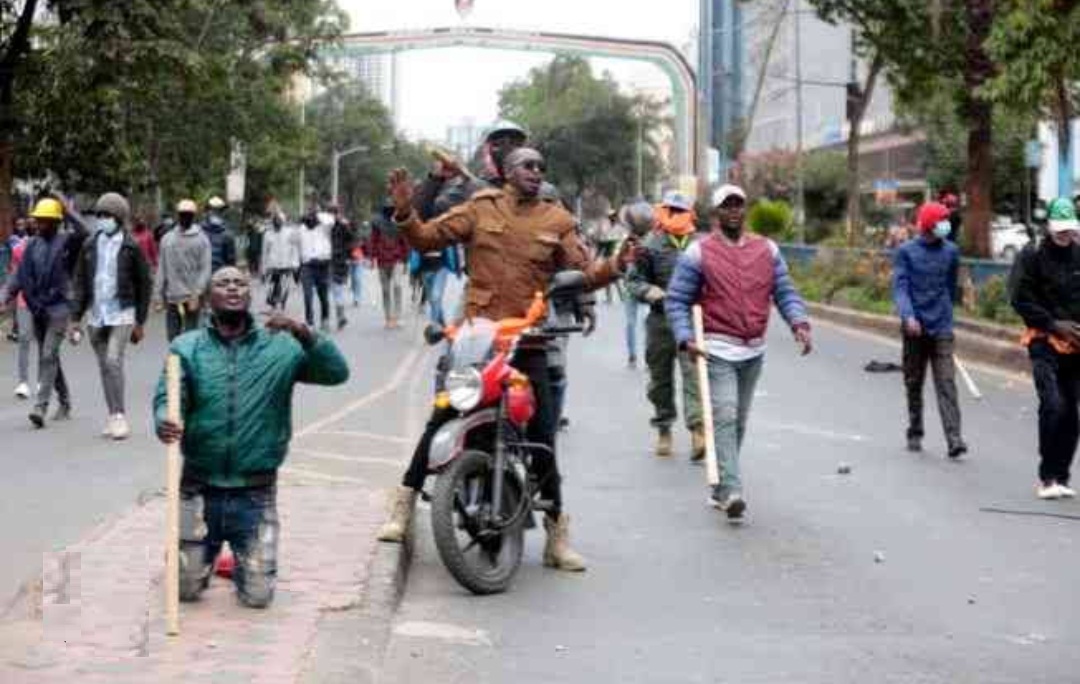
.While ‘Goon’ is a charged term implying criminality, Kenya is facing a turning point where informal militias are quietly becoming an auxiliary political force, operating outside the law but inside the political bloodstream.
What was once sporadic violence has now morphed into a systematic architecture of intimidation and harassment aimed at silencing citizens, disrupting protests, and shielding those in power from accountability.
Kenya’s democracy, once a beacon in the region, now stands on the edge-the shadows deepen before the nation wakes up to a crisis too entrenched to reverse.
It is a calculated, well-funded, and centrally coordinated assault on civic expression—one that mirrors the early collapse of democracy in a fragile African state.
Insiders, security officials, activists, and local organisers reveal a dangerous infrastructure powering this violence: Goons are recruited in estates, slums, and transport terminals with promises of cash, alcohol, protection, drugs and or political favours.
Politicians have become merchants of bloodshed, paying the goons to harm, destroy and even kill. The goons reveal networks, pay structures and power play – which they engage in ‘to make ends meet’.
Vehicles—often unmarked—are hired to ferry them to protests, rallies, and political meetings with coordination takes place in safe houses and hotels, sometimes hours before an event.
Weapons—ranging from crude tools to reinforcements disguised as “security”—are supplied by handlers linked to political offices.
In recent months, organised groups of hired thugs have been observed infiltrating peaceful demonstrations, attacking political gatherings, and trailing outspoken leaders and activists.
Their mission is unmistakable: weaponise fear, fracture public confidence, and suffocate any form of dissent before it can grow into meaningful resistance.
Individuals known for criminal activities wearing reflector jackets, military-like attire and boots mingle before violence erupts.
They move freely wielding machetes (mipini) ready to attack opponents of their funders and their supporters.
Sources within political circles speak of secret budgets, discreet cash drops, and payments routed through businessmen, contractors, and “mobilisers” during political events.
The goons normally receive payments ranging between Sh1,000 and Sh 5,000 per hired goon with larger operations receiving bulk payments running into hundreds of thousands.
Some financiers use charity events, community initiatives, or “development donations” as cover for mobilising gangs.
The deeper one digs, the clearer the pattern becomes: the violence is bought, protected, and politically profitable.
The gangs usually intimidate opposition gatherings, vandalise campaign caravans, assault journalists and activists, and disrupt civic actions with precision striking capacity.
Police often arrive late, stand down, or cooperate, creating an environment where hired attackers operate with near-total impunity.
Human rights defenders warn that this trend amounts to a creeping criminalisation of democratic expression—an attack not just on individuals, but on the foundation of the nation’s constitutional order.
Despite the growing concern, law enforcement agencies appear reluctant—or unwilling—to dismantle the networks behind these attacks. In some cases, they are seen accompanying the armed goons who attack dissent voices.
Security experts warn that this tactic is a blueprint drawn straight from countries where democracy was gradually suffocated.
They point to the alarming parallels between Kenya’s situation and the experience of the Democratic Republic of Congo, where political gangs, aligned militias, and state-sanctioned violence gradually hollowed out institutions and plunged the country into cycles of instability.
In the DRC, the erosion did not happen overnight. It started with silence—citizens too afraid to speak, leaders too compromised to act, and state agencies too captured to intervene. Kenya today stands worryingly close to that precipice.
In the DRC, political thugs first appeared as small, politically useful gangs. The lack of arrests and coherent investigations in Kenya is emboldening perpetrators, many of whom openly operate as extensions of political actors seeking to consolidate influence beyond legal means.
Civic groups fear that without decisive and impartial intervention, the nation risks entering a dangerous era where brute force overshadows the ballot, and intimidation replaces ideas in shaping political outcomes.
Experts warn that the cost of inaction will be devastating: reduced civic participation, rising radicalisation, and a public sphere governed by fear rather than freedom.
The Constitution’s promise of a democratic, open society is already being tested.
Kenya’s current trajectory bears an uncomfortable resemblance to the early days of the Democratic Republic of Congo’s descent into political chaos while the State is looking away.
As the country’s democracy collapses, Kenya is already dangerously sliding deep into various kinds of goonism subjecting the public to suffering and gripping the nation with fear.
Already, the majority of the ordinary Kenyans now fear participating in political activities, expressing opinions openly, or attending public demonstrations. Journalists report being trailed while dissenting political voices face attacks.
And this is how nations fall, how societies fracture and like the DRC, Kenya may only realise the gravity when its institutions have already been hollowed out, its citizens silenced, and its politics captured by brute force.
The latest incident of goon criminality is the attack of Vihiga Senator Godfrey Osotsi while in a Kisumu hotel.
Osotsi’s assault coming a few days after he was ousted from the position he held as the Deputy Party leader in ODM signals escalating goonism as Kenya’s political intimidation crisis deepens.
According to the of the Director of Communication, Vihiga Senate, Mr Osotsi had made a routine visit to the Acacia area for personal grooming (to take a shave) before proceeding to Java Restaurant, where he met a friend and interacted cordially with members of the public before a group of gun-wielding individuals confronted him, questioning his political stance and subsequently subjecting him to physical manhandling.
“They demanded to know why he is supporting the one-term movement that is opposing President William Ruto’s re-election bid,” explained Derick Luvega, the Senator’s Director of Communication. “The Senator’s security detail that was present exercised restraint to avoid discharging firearms in a public setting, which could have resulted in grave harm to innocent civilians.”
Mr Luvega condemned the incident which he termed as barbaric and cowardly act appearing to be premeditated and orchestrated.
“We call upon the National Police Service to act with urgency and thoroughness in investigating this incident. The availability of CCTV surveillance at Java Restaurant provides a critical starting point for identifying and apprehending those responsible.” Mr Luvega added noting that the rule of law must prevail and those behind this heinous act must be held accountable.
The assault on the Senator has become the flashpoint of a growing pattern of a worrying ecosystem of organised political goonism weaponised to silence dissent, derail public meetings and shrink the democratic space.
Osotsi’s attack is not any isolated outrage; it is a symptom of political culture increasingly reliant on hired thugs instead of ideas, pointing to a dangerous trajectory gripping Kenya.
Unless urgent action is taken by state agencies, political leaders, and civil society—Kenya risks crossing a threshold from which it may never return. A democracy infiltrated by violence becomes a democracy defined by violence.
If the government does not confront this menace now, it may soon wake up to find that the ballot no longer matters, the voice of the people no longer counts, and the republic it once knew has quietly slipped away.
Democracy for the Citizens Party deputy party leader Cleophas Malala while condemning the attack of Senator Osotsi regretted that the country was increasingly becoming unsafe, with armed goons wreaking havoc without consequence.
He called upon the security agencies to act swiftly and decisively to restore the rule of law and guarantee the safety of all citizens.
“This cannot be normalized.” Malala emphasised. “Lawlessness must not be allowed to take root in a democratic society. Kenyans deserve a country where security is assured, not one where impunity thrives.”
He asked the security agencies to conduct speedy investigations, accountability for those responsible and immediate end to the growing culture of anarchy saying “an attack on one leader is an attack on the democratic space we all share”.
Other leaders who echoed their sentiments include Siaya Governor James Orengo, Sabot MP Caleb Amis and Kakamega Senator Boni Khalwale.
“The attack was a random and coordinated act of intimidation-an attempt to silence the Senator,” said Mr Orengo demanding immediate release of the CCTV footage and swift justice.
“This divide and rule tactic will fail,” he added.
Mr Amis regretted that the attack of leaders by goons was undermining the democratic space and freedoms Kenyans are supposed to enjoy.
“Kenya is a democratic nation where everyone enjoys freedom to express themselves and participate in politics without fear of intimidation.” He said. “Such acts of violence are unacceptable and those responsible must be brought to justice,”